
Ideation

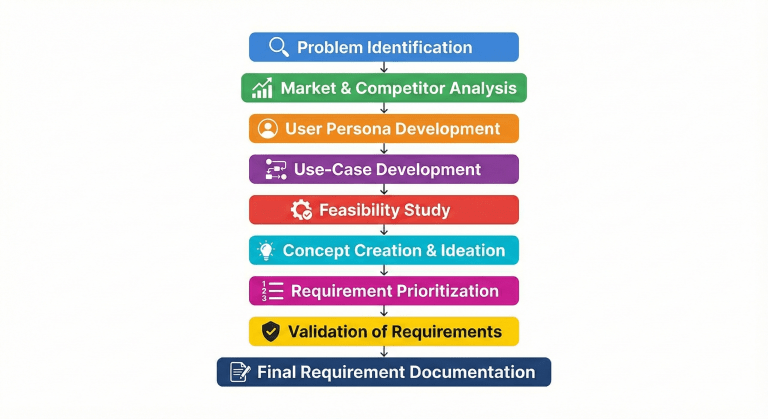
Problem Identification
Understanding the pain points that need a solution.
Conducted deep analysis of user challenges, unmet needs, and workflow gaps.
Studied existing solutions and identified inefficiencies or shortcomings.
Defined key user frustrations such as manual monitoring, delays in alerts, unreliable theft/security detection, etc.
Mapped out real-world scenarios where the product must operate.
Market & Competitor Analysis
Evaluating market demand—and ensuring the idea is commercially viable.
Performed competitive benchmarking to assess existing offerings.
Identified gaps in pricing, features, connectivity, usability, and reliability.
Analyzed customer reviews of similar products for insights into unmet expectations.
Assessed market size, growth rate, and demand in targeted segments.
User Persona Development
Understanding who the product is being built for.
Created detailed personas representing different customer segments.
Studied demographic, behavioral, and technological usage patterns.
Defined primary user groups such as:
Homeowners needing theft prevention
Small business owners
Warehouse/factory supervisors
High-value asset managers
Captured needs, motivations, and constraints for each persona.
Use-Case Development
Capturing real-world scenarios that the product must support.
Defined primary use-cases such as intrusion detection, alert sending, real-time messaging, low-battery notification, connectivity loss alerts, etc.
Built workflow diagrams showing step-by-step user interactions.
Identified edge cases and abnormal scenarios (no network, power failure, sensor malfunction).
Feasibility Study
Evaluating technical, operational, and commercial feasibility.
Technical Feasibility
Sensor selection
Connectivity options (WiFi, GSM, LTE, BLE)
Processor/battery requirements
Operational Feasibility
Manufacturing capability
Maintenance model
Ease of deployment
Financial Feasibility
Estimated BOM (Bill of Materials)
Market pricing
ROI and scalability
Concept Creation & Ideation
Transforming findings into actionable product concepts.
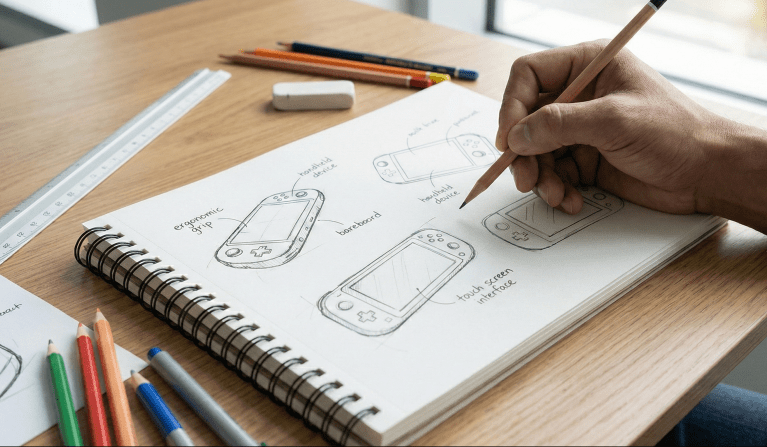
Created multiple concept sketches, rough prototypes, and architecture ideas.
Explored variations in form factor, features, and user experience.
Compared concepts on performance, cost, and customer benefit.
Conducted internal review cycles and refined the best concept.
Requirement Prioritization
Selecting what features are essential for MVP vs future versions.
Divided requirements into:
MVP (Minimum Viable Product)
Enhanced Version
Future Expansion
Prioritized based on impact, complexity, cost, and user need.
Eliminated low-value or redundant features.
Validation of Requirements
Ensuring the chosen concept meets real customer needs.
Conducted customer interviews and collected feedback on early concepts.
Tested the feasibility of the idea using mockups or low-fidelity prototypes.
Validated willingness-to-pay, usability, expected performance, and reliability expectations.
Cross-checked requirements with compliance needs (MTCTE, BIS, WPC, battery certifications, etc., if applicable).
Final Requirement Documentation
Creating complete documentation for development teams.
Prepared PRD (Product Requirement Document)
Defined specifications, KPIs, and acceptance criteria
Created feature list, user flows, wireframes, and system architecture overview
Documented all constraints, dependencies, and certification requirements